
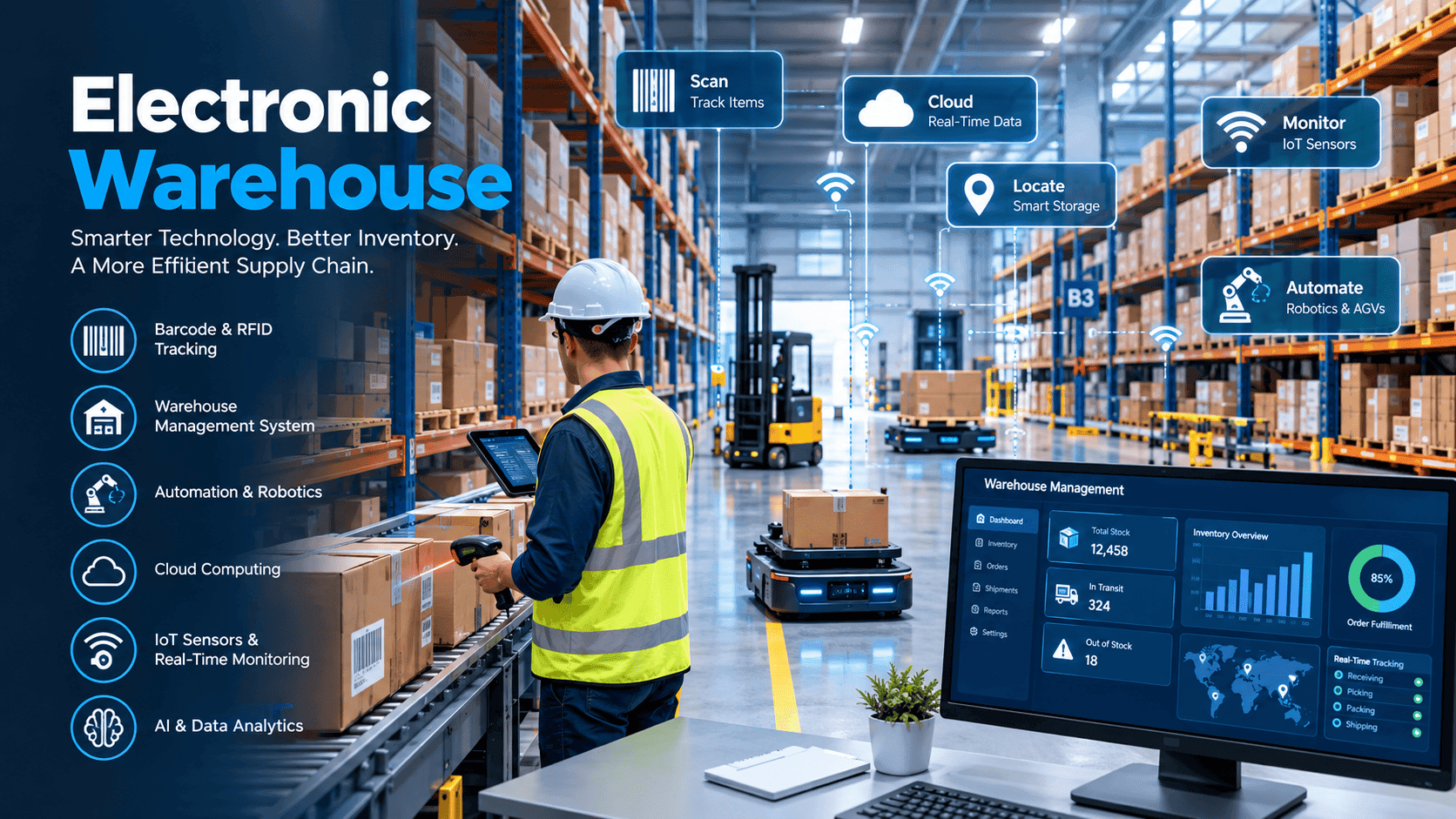
In today’s fast-moving business environment, efficient inventory management is more important than ever. Companies need to store, organize, track, and distribute products quickly while keeping costs under control. Traditional warehouses often depend on manual processes, paperwork, and human supervision, which can lead to inventory errors, delays, and unnecessary expenses. An electronic warehouse offers a smarter solution by combining physical storage facilities with digital technology, automation, real-time data, and intelligent inventory management systems.
An electronic warehouse, sometimes called a smart warehouse or digital warehouse, uses technologies such as warehouse management software, barcode scanners, RFID, sensors, cloud computing, robotics, and artificial intelligence to improve warehouse operations. These technologies help businesses know what products they have, where those products are located, how much stock is available, and when inventory needs to be replenished.
As e-commerce, manufacturing, retail, and logistics continue to expand, electronic warehouses are becoming an important part of modern supply chain management.
What Is an Electronic Warehouse?
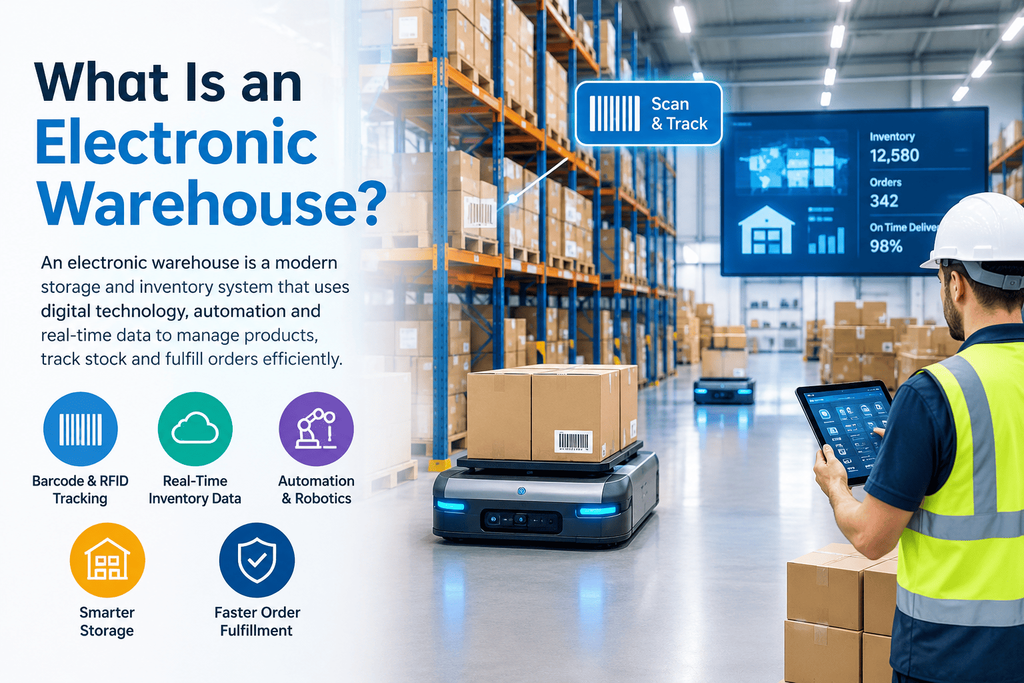
An electronic warehouse is a technology-enabled storage and distribution facility where inventory and warehouse operations are managed primarily through digital systems.
Unlike a traditional warehouse, where employees may manually record products and update stock information, an electronic warehouse uses connected software and hardware to collect and process information automatically. Products can be identified using barcodes or RFID tags, while warehouse management systems record their movement from receiving to storage, picking, packing, and shipping.
The main purpose of an electronic warehouse is to create greater accuracy, efficiency, visibility, and control.
For example, when a shipment arrives, workers can scan each product using a barcode scanner. The warehouse management system can then automatically update the inventory database. When an order is received, the system can identify the product’s location and guide employees or automated equipment to retrieve it.
This reduces the need for manual record keeping and allows businesses to make faster, more informed decisions.
How Does an Electronic Warehouse Work?
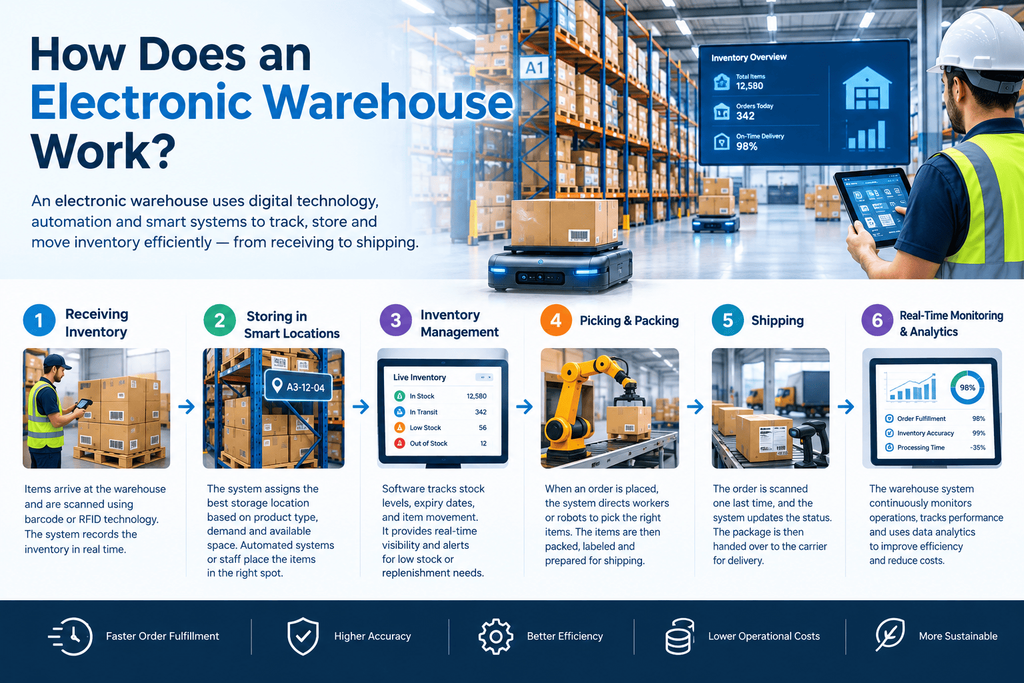
An electronic warehouse operates through the integration of several technologies and processes. The exact setup varies depending on the size and requirements of a business, but the basic workflow generally follows several stages.
1. Receiving Goods
When products arrive at the warehouse, employees scan their barcodes or RFID tags. The system records information such as product identification, quantity, supplier, and arrival time.
The inventory database is updated immediately, providing an accurate record of incoming stock.
2. Inventory Storage
After receiving, products are assigned specific storage locations. A warehouse management system can determine where products should be placed based on factors such as product size, demand, weight, and storage requirements.
Digital location tracking makes it easier for employees to find products when they are needed.
3. Order Processing
When a customer places an order, the warehouse management system receives the information and creates a picking task. Employees may receive instructions through handheld scanners, mobile devices, or warehouse displays.
In highly automated warehouses, robots or automated guided vehicles may transport products between storage and packing areas.
4. Picking and Packing
The system guides workers to the correct products and quantities. Once an item is picked, it can be scanned to confirm that the correct product has been selected.
After picking, products are moved to the packing area, where they are prepared for shipment.
5. Shipping and Tracking
Before products leave the warehouse, they can be scanned again. The system records the shipment and updates inventory levels.
This creates a digital record of the product’s movement and can also help businesses provide customers with accurate order and delivery information.
Key Technologies Used in Electronic Warehouses
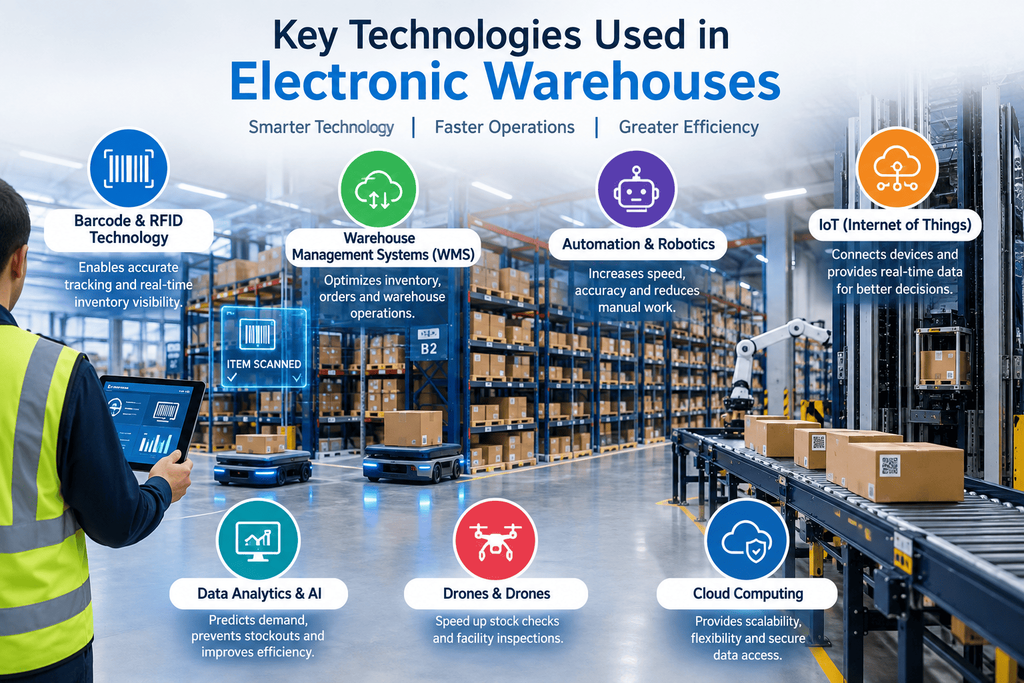
Several technologies work together to create an efficient electronic warehouse.
Warehouse Management System
A Warehouse Management System (WMS) is often the central technology in a smart warehouse. It manages inventory, orders, storage locations, picking activities, receiving, shipping, and reporting.
A WMS provides warehouse managers with greater visibility into daily operations and helps coordinate different processes.
Barcode Technology
Barcodes are one of the most widely used technologies for inventory tracking. Workers can scan products quickly using handheld devices or fixed scanners.
Barcode systems are relatively simple and cost-effective, making them suitable for businesses of many sizes.
RFID Technology
Radio Frequency Identification, or RFID, uses electronic tags to identify products and assets. Unlike traditional barcode scanning, RFID systems can sometimes identify multiple tagged items without requiring direct line-of-sight scanning.
This can improve inventory visibility and speed up certain warehouse processes.
Internet of Things
IoT devices such as sensors, smart shelves, cameras, and connected equipment can collect information from different parts of the warehouse.
For example, sensors can monitor temperature, humidity, equipment status, or inventory levels. This information can be transmitted to centralized systems for analysis and monitoring.
Robotics and Automation
Robots can perform repetitive warehouse tasks such as transporting goods, sorting products, moving containers, and assisting with picking.
Automation can reduce physical workload, increase processing speed, and help businesses handle large order volumes.
Cloud Computing
Cloud-based warehouse systems allow businesses to access warehouse data from different locations. Managers can monitor inventory, orders, and performance without being physically present inside the warehouse.
Cloud technology can also make it easier to connect warehouse operations with other business systems.
Artificial Intelligence
Artificial intelligence and machine learning can analyze warehouse data to identify patterns and improve decision-making.
For example, AI can help forecast product demand, optimize storage locations, identify unusual inventory activity, and improve order fulfillment strategies.
Benefits of an Electronic Warehouse
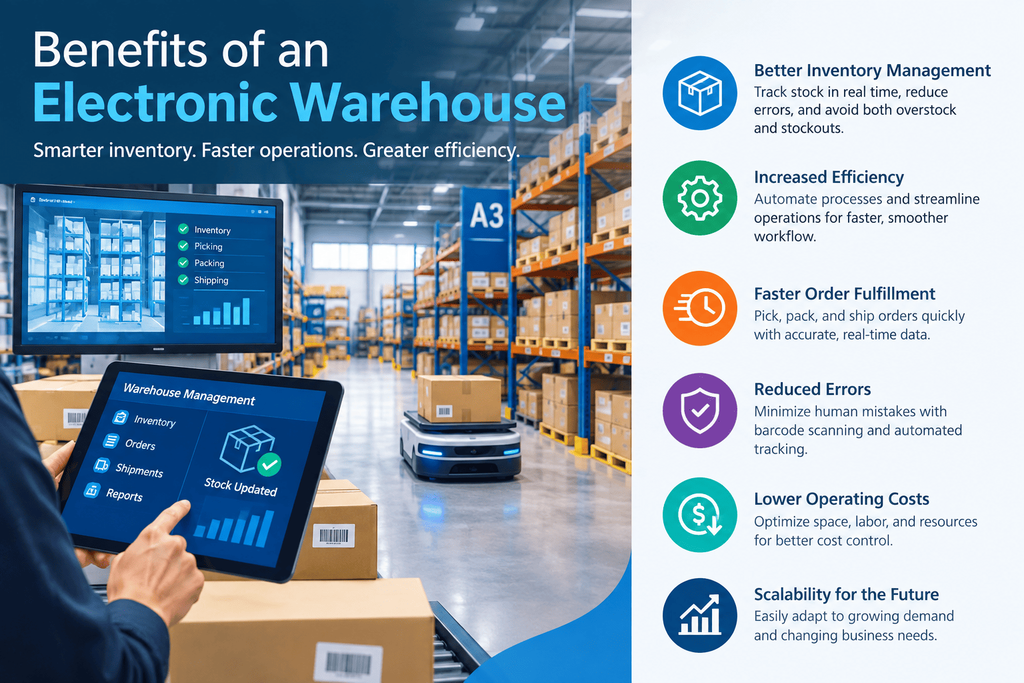
Moving from traditional warehouse management to an electronic system can provide several important advantages.
Improved Inventory Accuracy
Manual inventory management can result in data entry mistakes, misplaced products, and inaccurate stock counts. Electronic systems automatically record many inventory transactions, reducing the likelihood of human error.
Accurate inventory information helps businesses avoid both overstocking and stock shortages.
Faster Operations
Digital systems can speed up receiving, picking, packing, and shipping processes. Employees can find products more quickly because their locations are recorded in the system.
Automation can further increase processing speed in high-volume facilities.
Real-Time Inventory Visibility
One of the biggest advantages of an electronic warehouse is real-time visibility.
Managers can see current inventory levels, pending orders, incoming shipments, and other operational information through digital dashboards. This enables faster and more informed decisions.
Reduced Operating Costs
Although implementing an electronic warehouse requires an initial investment, technology can reduce long-term operating expenses.
Better inventory control can reduce waste and unnecessary storage. Automation can also reduce the amount of time employees spend on repetitive tasks.
Better Customer Service
Customers expect orders to be processed accurately and delivered quickly. Electronic warehouse systems can improve order accuracy and fulfillment speed.
Businesses can also provide more reliable information about product availability and shipment status.
Better Use of Warehouse Space
Digital systems can analyze inventory movement and help businesses determine where products should be stored.
Fast-moving products can be positioned in easily accessible locations, while slower-moving inventory can be stored in less convenient areas. This can improve warehouse space utilization and reduce unnecessary movement.
Scalability
Electronic warehouse systems can help businesses manage increasing order volumes without requiring the same proportional increase in manual labor.
This makes digital warehouse technology particularly valuable for growing businesses and e-commerce companies.
Challenges of Implementing an Electronic Warehouse
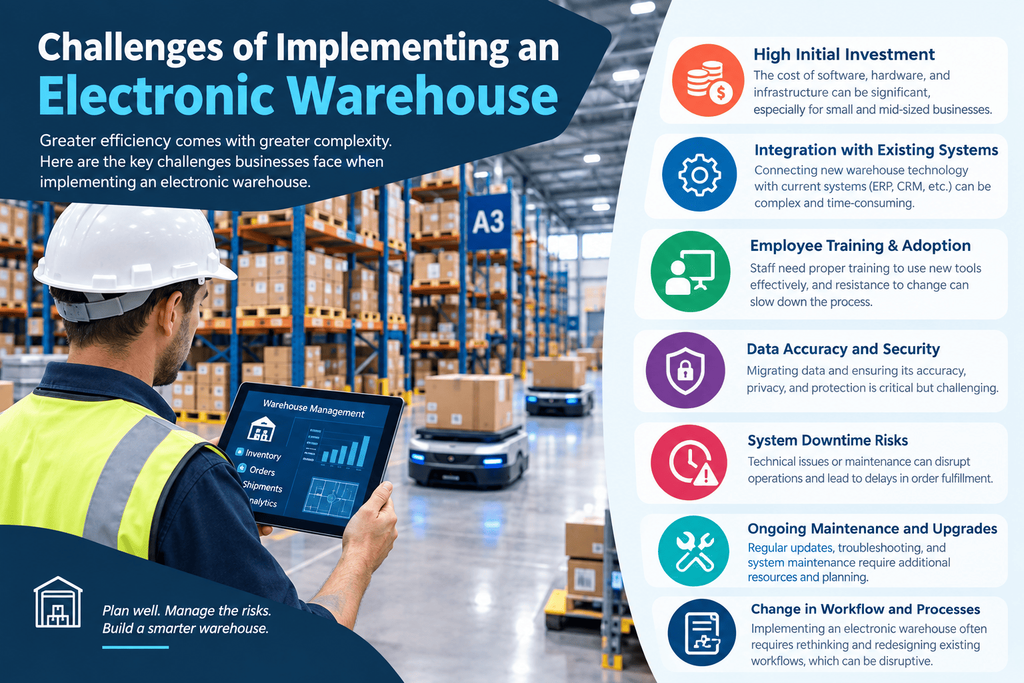
Despite its many advantages, implementing an electronic warehouse can present challenges.
Initial Investment
Hardware, software, scanners, sensors, networking equipment, robotics, and integration services can require significant investment.
Businesses should evaluate their requirements carefully and choose technologies that provide measurable value.
Employee Training
Employees need to understand how to use new warehouse software and equipment. Training is essential to ensure that workers can operate systems correctly and respond to errors.
A well-designed implementation should consider employees as part of the technology transformation rather than simply replacing existing processes.
System Integration
A warehouse management system may need to communicate with accounting software, enterprise resource planning systems, e-commerce platforms, transportation systems, and other applications.
Poor integration can create duplicate data, delays, or inaccurate information.
Cybersecurity
As warehouses become increasingly connected, cybersecurity becomes more important. Inventory information, business data, customer details, and operational systems need appropriate security measures.
Companies should use strong access controls, secure networks, regular updates, backups, and appropriate monitoring.
Maintenance
Electronic equipment and software require ongoing maintenance. Sensors can fail, scanners may need replacement, and software requires updates.
Businesses should have maintenance and support plans to minimize operational disruptions.
Electronic Warehouse vs. Traditional Warehouse
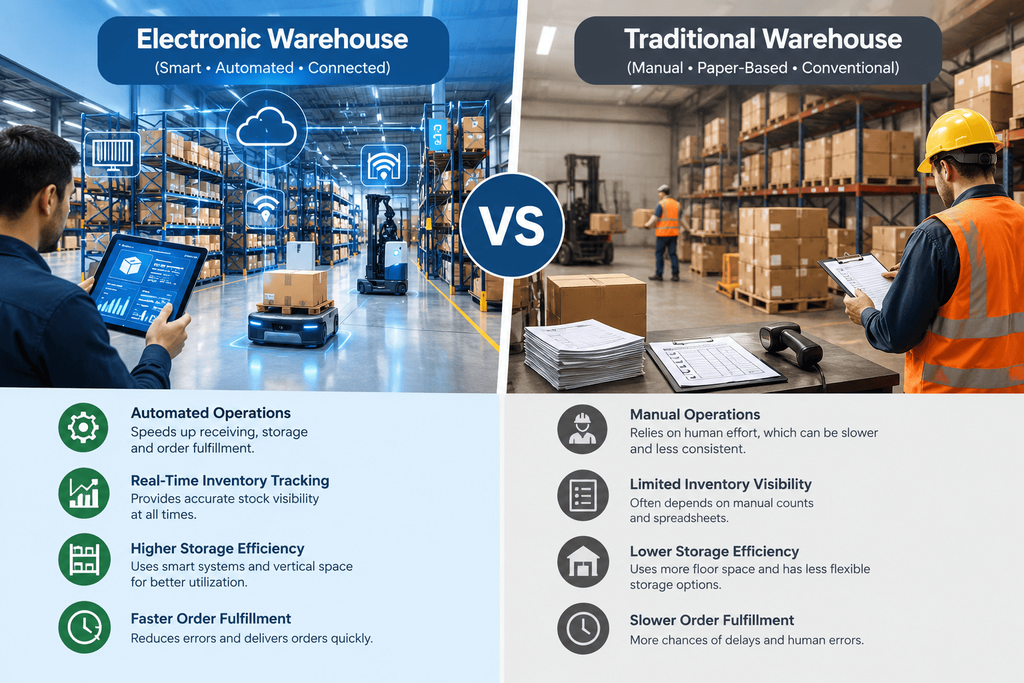
The key difference between traditional and electronic warehouses is the level of technology used to manage operations.
A traditional warehouse may rely heavily on manual counting, paperwork, spreadsheets, and employee experience. An electronic warehouse uses centralized digital systems to collect, analyze, and share information.
Traditional warehouses can still be effective for certain businesses, particularly those with simple inventory requirements. However, electronic warehouses provide greater automation and visibility as operational complexity increases.
The goal is not necessarily to automate every task. Instead, businesses should identify processes where technology can provide the greatest improvement.
The Future of Electronic Warehousing
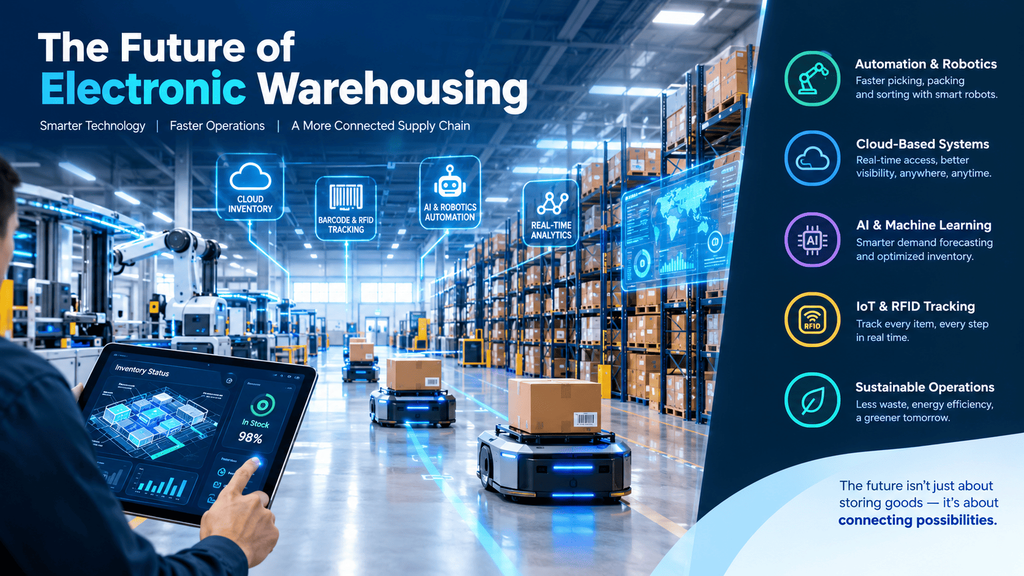
The future of warehousing is expected to become increasingly connected, automated, and data-driven.
Artificial intelligence will continue to improve demand forecasting and operational planning. Robotics can take on more material-handling tasks, while IoT sensors can provide continuous information about inventory and equipment.
Digital twins may also become more useful for modeling warehouse operations virtually. Businesses could use digital simulations to test storage layouts, workflows, and capacity changes before making physical modifications.
Autonomous mobile robots, computer vision, predictive analytics, and advanced warehouse software are also likely to play increasingly important roles.
At the same time, human workers will remain essential for many warehouse activities. Technology is most effective when it supports employees, reduces repetitive work, improves safety, and helps people make better decisions.
How Businesses Can Implement an Electronic Warehouse
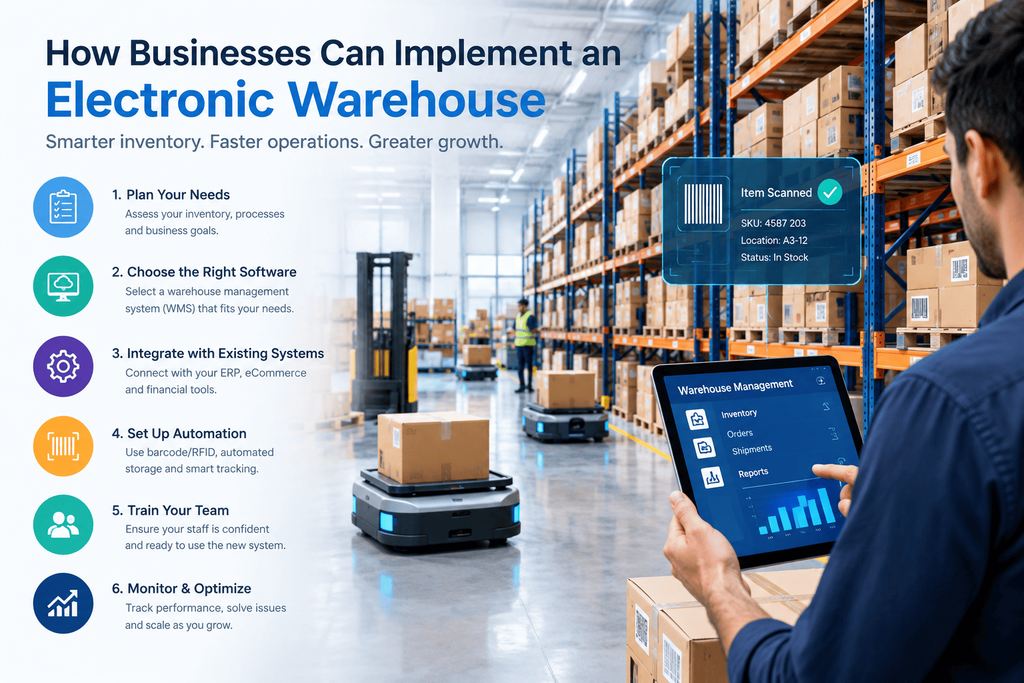
Businesses considering electronic warehouse technology should start with a clear assessment of their current operations.
First, identify the biggest problems in the warehouse. These could include inventory inaccuracies, slow picking, poor space utilization, delayed shipments, or limited visibility.
Next, establish measurable objectives. For example, a company may want to improve inventory accuracy, reduce order-processing time, or increase daily order capacity.
The business can then select appropriate technologies based on its budget and operational requirements. A small warehouse may benefit from barcode scanning and basic warehouse management software, while a large distribution center may require robotics, RFID, IoT sensors, and advanced automation.
Implementation should generally be gradual. Testing systems in selected warehouse areas can help identify problems before a full-scale rollout.
Finally, businesses should continuously monitor performance and improve their processes based on operational data.
Conclusion
An electronic warehouse is more than a storage facility equipped with computers. It is an integrated system that combines physical infrastructure, digital information, automation, and intelligent technology to improve inventory and supply chain operations.
From barcode scanners and warehouse management systems to RFID, IoT, robotics, cloud computing, and artificial intelligence, modern technologies can transform how businesses store and move products.
The major benefits include improved inventory accuracy, faster operations, real-time visibility, better space utilization, lower operational costs, and improved customer service. While challenges such as investment, training, integration, cybersecurity, and maintenance must be addressed, the long-term advantages can make electronic warehousing a valuable investment.
As businesses face increasing customer expectations and growing supply-chain complexity, electronic warehouses will continue to play an important role. Companies that adopt the right technologies and combine them with effective processes can build warehouses that are faster, smarter, more accurate, and better prepared for the future.
Frequently Asked Questions (FAQs)
Q: Are these electronics brand new or refurbished? A: Items in our clearance event include a mix of factory-sealed new overstock, manufacturer-refurbished items, and open-box display models. The exact condition (New, Refurbished, or Open-Box) is clearly indicated on each item’s product page.
Q: How are prices lower than wholesale rates? A: We clear out overstock, end-of-line models, and liquidated inventory directly from regional distribution hubs. By cutting out middleman distributors and selling directly to you, we pass the savings straight on to our customers.
Q: Do these clearance electronics come with a warranty? A: Yes. All clearance items include either a full manufacturer warranty or our standard clearance guarantee, ensuring your electronic equipment operates properly out of the box.
Q: What is the return policy for clearance purchases? A: Clearance items are eligible for return within 30 days of receipt if they arrive defective or significantly damaged. Because stock is limited, replacements depend on remaining inventory; if unavailable, a full refund will be processed.
Q: Is shipping included in the clearance price? A: Shipping rates are calculated at checkout based on location and item dimensions, though bulk purchases and qualifying promotional items may be eligible for flat-rate or free shipping.