
In today’s digital world, data has become one of the most valuable resources for businesses, organizations, and professionals. Companies use data to understand customers, improve operations, make better decisions, and discover new opportunities. As the demand for data professionals continues to grow, specialized training programs have become increasingly important. One name that frequently appears in discussions about data analytics careers is The Data School.
The Data School is known for providing practical training and professional development in data analytics and visualization. It has attracted people who want to build careers in areas such as data analysis, business intelligence, data visualization, and consulting. For individuals interested in transforming data into meaningful insights, understanding what The Data School offers can be a useful starting point.
What Is The Data School?

The Data School is a data analytics training program designed to help individuals develop practical skills for working with data. Rather than focusing only on traditional classroom learning, its approach emphasizes hands-on projects, real-world problems, collaboration, and professional development.
A major attraction of The Data School is its focus on tools and techniques that are commonly used in modern data analytics. Students can learn how to work with data, create visualizations, communicate insights, and solve business problems.
The program is particularly associated with Tableau, a popular data visualization and business intelligence platform. Depending on the location and program structure, students may also encounter other analytics technologies and methods.
Why Is Data Analytics Important?
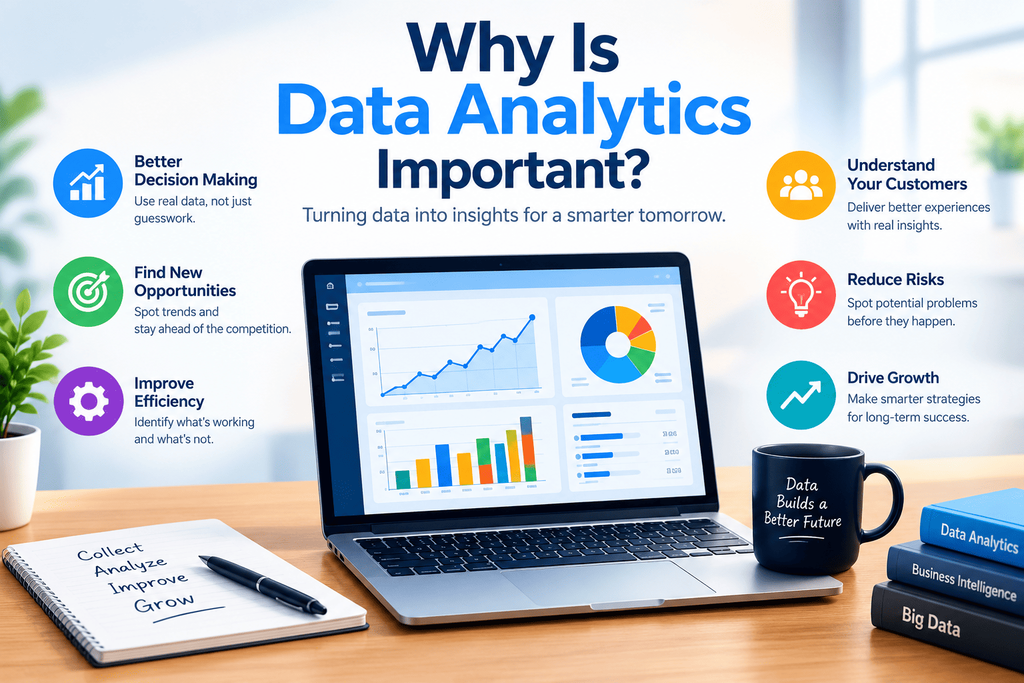
Before discussing The Data School in more detail, it is important to understand why data analytics has become such an important career field.
Every day, businesses generate enormous amounts of information. Websites collect visitor data, retailers track purchases, financial institutions monitor transactions, and organizations measure performance through countless metrics.
However, raw data by itself is not always useful. Organizations need professionals who can transform large datasets into understandable information.
Data analytics helps businesses answer questions such as:
- What products are performing well?
- Which customers are most valuable?
- Why are sales increasing or decreasing?
- Where are operational problems occurring?
- What trends may affect future performance?
- How can a company reduce unnecessary costs?
A skilled data analyst can examine information, identify patterns, and communicate useful conclusions to decision-makers.
What Can You Learn at The Data School?

One of the key benefits of a specialized data training program is the opportunity to develop several complementary skills.
Data Visualization
Data visualization is an important part of modern analytics. Instead of presenting decision-makers with hundreds of rows of numbers, analysts can use charts, dashboards, maps, and other visual elements to make information easier to understand.
Students can learn principles of effective visualization, including choosing appropriate charts, organizing dashboards, highlighting important findings, and presenting information clearly.
Tableau Skills
Tableau is widely recognized as a business intelligence and data visualization platform. Learning Tableau can help aspiring analysts create interactive dashboards and explore datasets visually.
The Data School has historically placed significant emphasis on Tableau training. Students can develop practical experience creating dashboards and using visual analytics to answer business questions.
Data Preparation
Before data can be analyzed, it often needs to be cleaned and organized. Real-world datasets may contain missing values, duplicate records, inconsistent formats, or other problems.
Data preparation teaches analysts how to turn raw information into a more useful dataset for analysis.
Analytical Thinking
Learning software is only one part of becoming a successful data analyst. Professionals also need analytical thinking.
The ability to ask the right questions, investigate problems, identify patterns, and determine what information is relevant can be more important than simply knowing how to operate a particular tool.
Communication
A data analyst may discover an important trend, but the discovery has little value if it cannot be communicated effectively.
The Data School’s practical approach can help students develop presentation and communication skills. Analysts often need to explain technical findings to managers, executives, clients, or people who have little technical knowledge.
The Importance of Hands-On Learning

Traditional education can provide valuable theoretical knowledge, but employers also want candidates who know how to apply their skills.
Hands-on learning gives students opportunities to work through realistic problems. Instead of simply reading about data visualization, learners can practice building dashboards and explaining what the data means.
This type of experience can help students develop confidence.
For example, a learner might be given a dataset containing sales information and asked to identify the best-performing products. They could clean the data, analyze sales trends, build a dashboard, and present their findings.
This process is much closer to the work performed by professional analysts.
Who Should Consider The Data School?
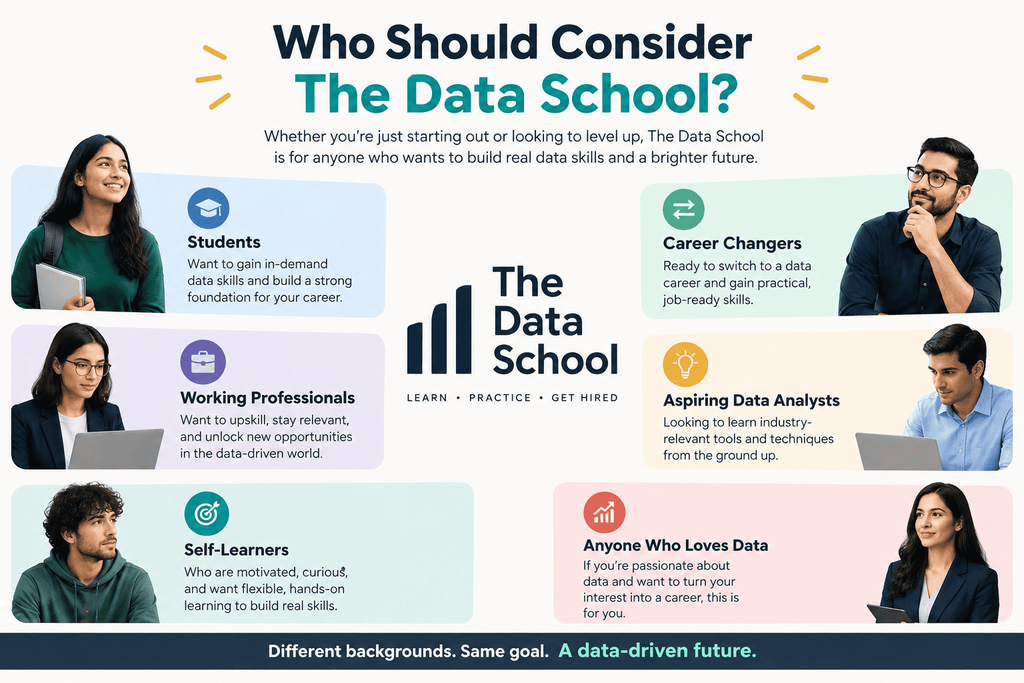
The Data School may be attractive to people from different educational and professional backgrounds.
You do not necessarily need to be an experienced programmer to become interested in data analytics. People with backgrounds in business, finance, marketing, education, science, mathematics, and other fields may find data analytics useful.
The program can be particularly interesting for:
- Recent graduates
- Career changers
- Aspiring data analysts
- Business intelligence enthusiasts
- Tableau learners
- Professionals interested in data visualization
- People who enjoy solving problems
- Individuals interested in consulting careers
A strong interest in learning, communication, and analytical thinking can be just as important as previous technical experience.
Career Opportunities After Data Analytics Training
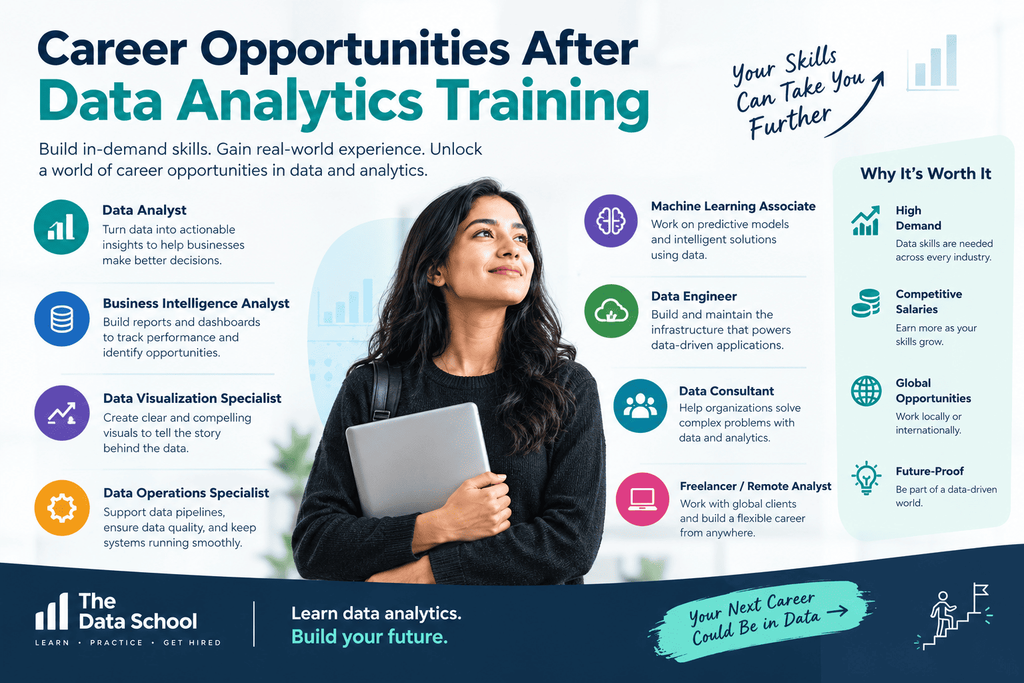
Data analytics skills can open the door to a variety of career paths.
Data Analyst
Data analysts examine datasets to identify trends and provide useful insights. They may work with sales, customer, financial, marketing, or operational data.
Business Intelligence Analyst
Business intelligence analysts help organizations understand performance through reports, dashboards, and analytical systems.
Data Visualization Specialist
These professionals focus on presenting complex information in clear and engaging visual formats.
Analytics Consultant
Analytics consultants work with organizations to solve business problems using data. Consulting can involve analyzing information, creating dashboards, presenting recommendations, and working directly with clients.
Business Analyst
Business analysts investigate organizational problems and identify opportunities for improvement. Data skills can be valuable in this role because many business decisions depend on quantitative information.
Building a Data Analytics Portfolio
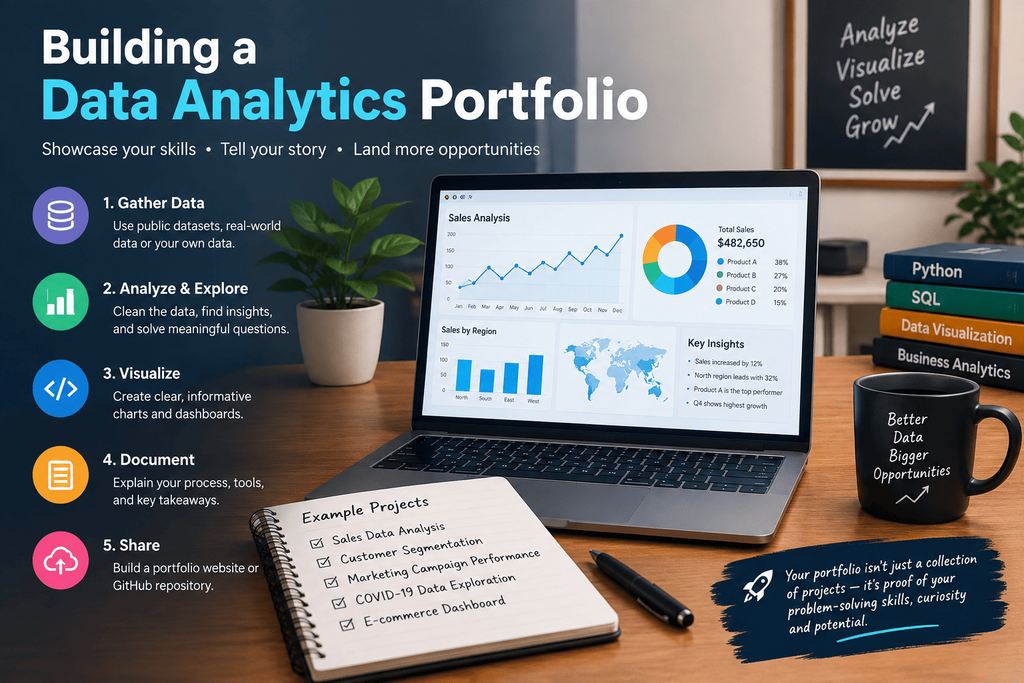
One of the most useful things aspiring analysts can do is create a portfolio.
A portfolio demonstrates what you can actually do rather than simply listing skills on a resume.
A good data analytics portfolio might include:
- Data cleaning projects
- Interactive dashboards
- Business case studies
- Sales analysis
- Customer behavior analysis
- Financial data analysis
- Geographic visualizations
- Written explanations of analytical findings
When creating portfolio projects, focus on the problem you are solving rather than simply making attractive charts.
For example, instead of creating a dashboard without context, explain the business question, describe the data, show your analytical process, and provide conclusions.
The Role of Tableau in Data Careers
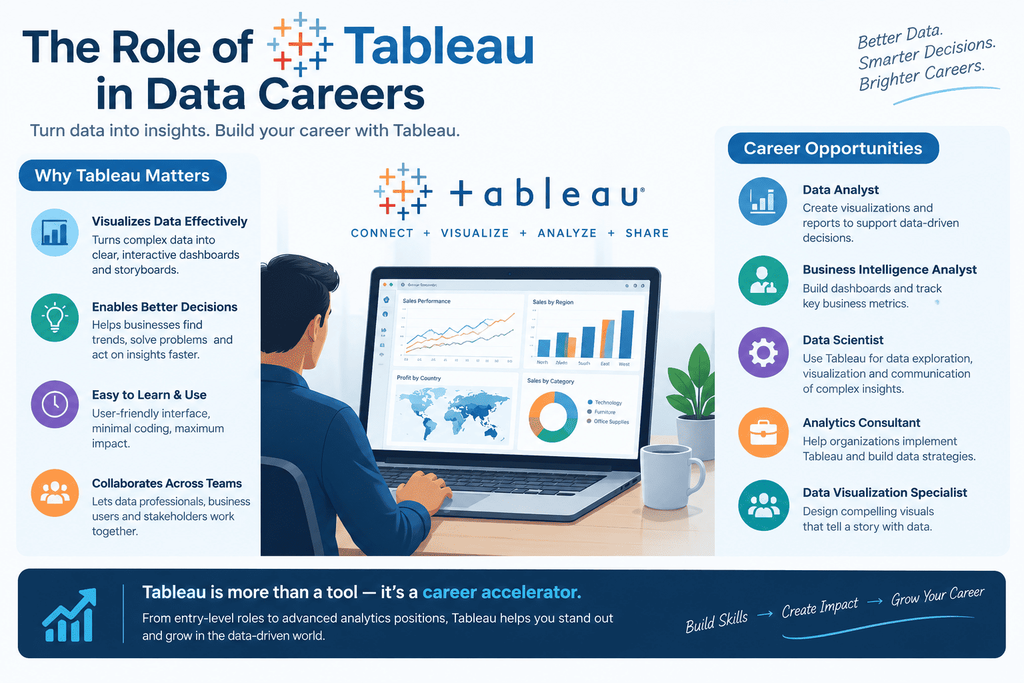
Tableau has become an important tool for organizations that need to analyze and communicate information.
Its visual interface allows users to explore data and create interactive dashboards. This makes it useful for organizations where decision-makers need quick access to business information.
Learning Tableau can therefore be a valuable addition to a data analytics skill set.
However, aspiring analysts should remember that tools are only one part of the profession. Strong analysts also need knowledge of data concepts, statistics, business processes, communication, and critical thinking.
Advantages of Practical Data Training
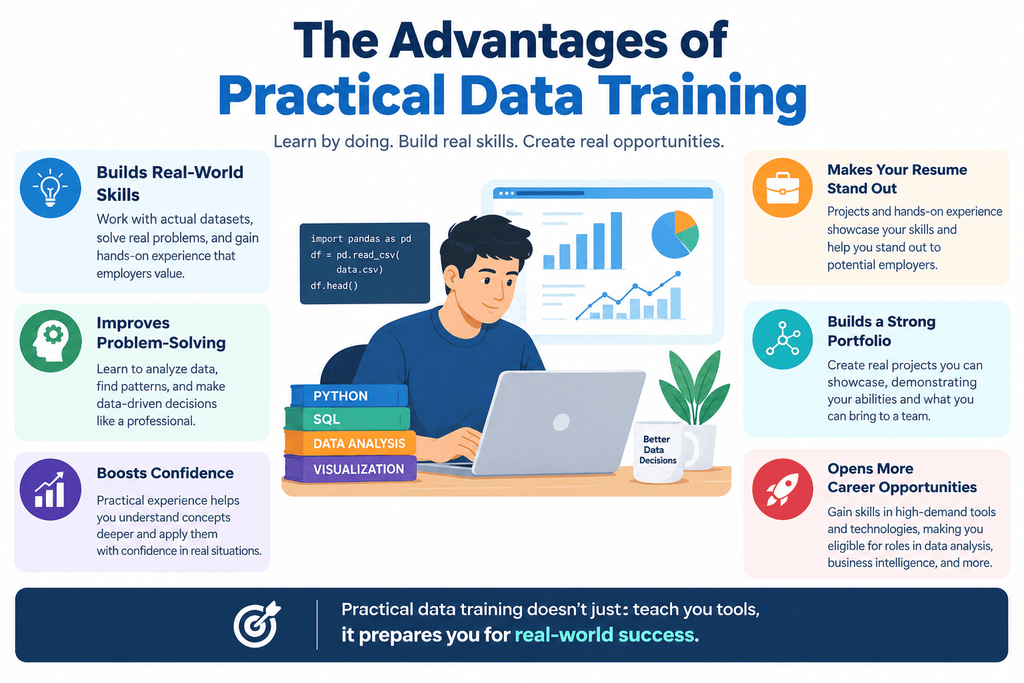
There are several advantages to learning data analytics through practical projects.
Real-World Experience
Practical projects can expose learners to situations that are more similar to professional work.
Faster Skill Development
Regularly using analytics tools can help learners become more comfortable with them.
Better Communication
Presenting findings helps students learn how to explain technical information to different audiences.
Professional Confidence
Completing realistic projects can make learners more confident when applying for jobs or working with clients.
Portfolio Development
Projects completed during training may provide ideas or material for a professional portfolio, depending on program requirements and permissions.
What Skills Should You Develop Alongside The Data School?
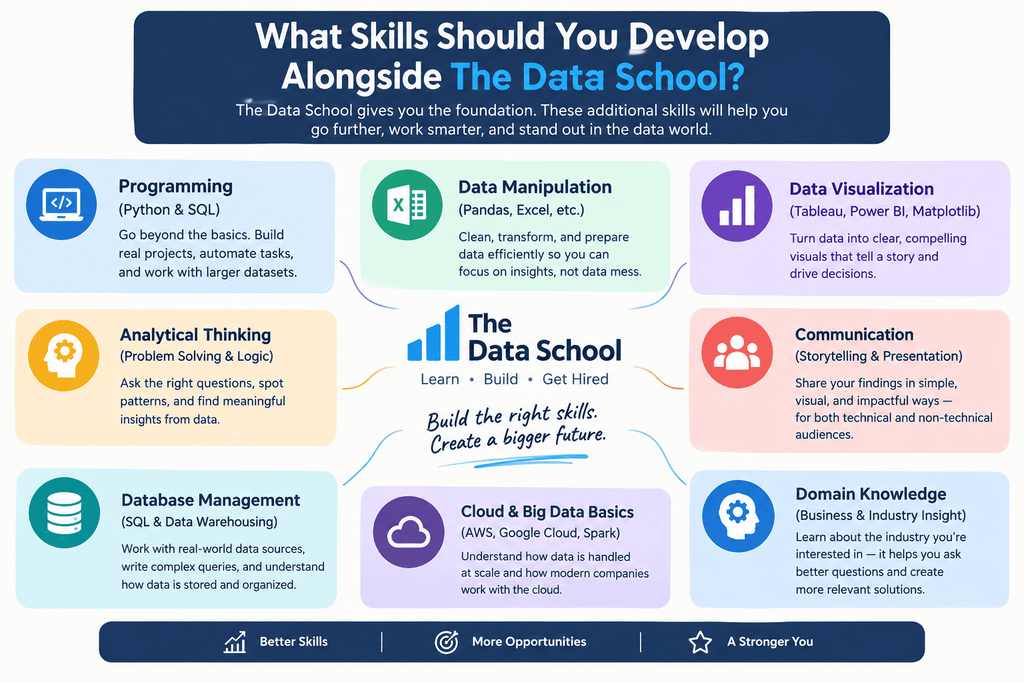
If you are preparing for a career in data analytics, consider developing a broad range of skills.
SQL
SQL is widely used for retrieving and manipulating information stored in databases. Understanding SQL can significantly improve your ability to work with business data.
Excel
Excel remains an important tool in many organizations. Knowledge of formulas, pivot tables, charts, and data-cleaning techniques can be useful.
Statistics
Basic statistics can help analysts understand distributions, averages, relationships, variation, and trends.
Python
Python is popular for data analysis, automation, and advanced analytics. It can be especially useful as you progress into more technical data roles.
Storytelling
Data storytelling combines analysis, visualization, and communication. It helps transform analytical results into a narrative that decision-makers can understand.
Tips for Starting a Data Analytics Career
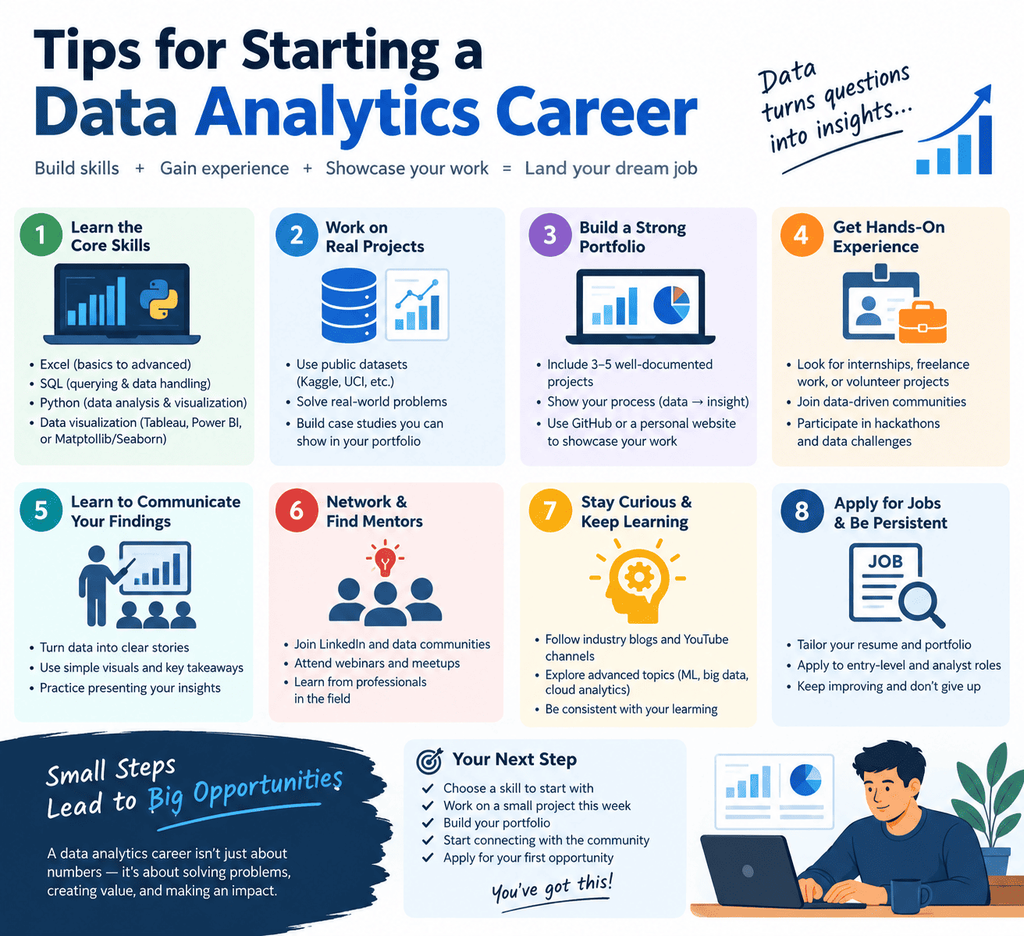
If you are interested in The Data School or a similar data analytics program, start by developing a strong foundation.
First, learn the basics of data analysis. Understand how datasets are structured and how analysts approach business questions.
Next, choose an analytics visualization tool and practice creating dashboards.
Then, work on independent projects. Public datasets can provide excellent opportunities for practice.
You should also learn SQL and basic statistics. These skills complement visualization software and make you a more well-rounded candidate.
Finally, practice explaining your findings. A strong analyst should be able to answer not only “What happened?” but also “Why did it happen?” and “What should we do next?”
Is The Data School Worth Considering?
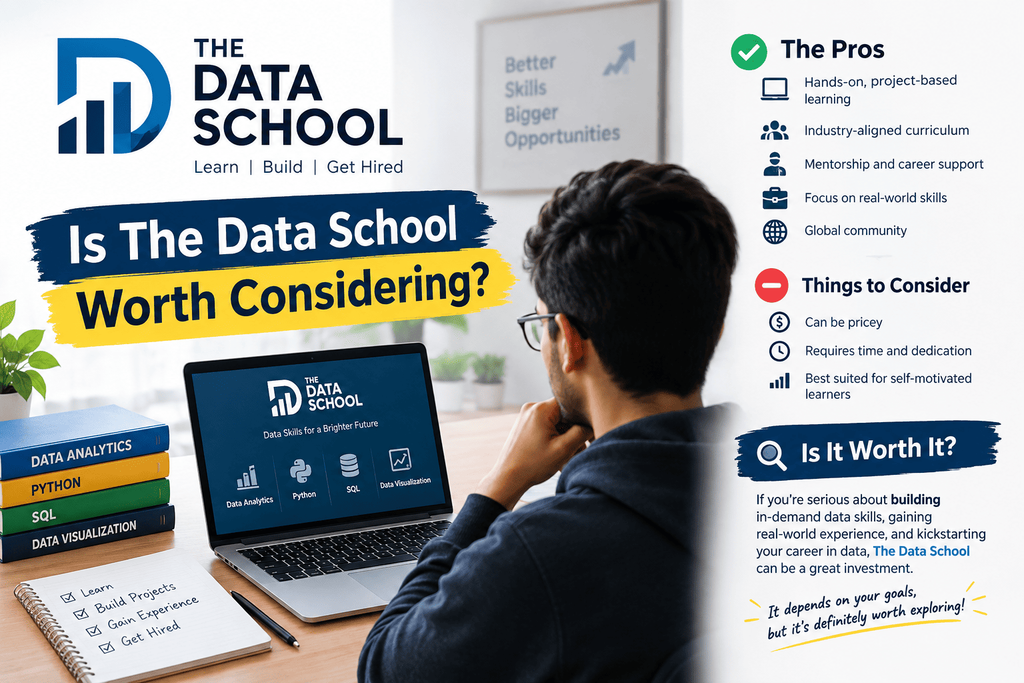
Whether The Data School is right for you depends on your career goals, learning preferences, location, eligibility, and the specific program available to you.
People who prefer hands-on learning and want to develop practical analytics skills may find this type of training especially valuable.
Before applying, prospective students should research the current program structure, entry requirements, training curriculum, locations, career opportunities, and application process.
It is also useful to compare The Data School with other data analytics bootcamps, university programs, online courses, and independent learning options.
Final Thoughts
The Data School represents an interesting pathway for people who want to develop practical data analytics and visualization skills. Its emphasis on hands-on learning, data visualization, Tableau, communication, and professional development can help learners prepare for careers in an increasingly data-driven economy.
However, becoming a successful data professional requires more than learning one software platform. SQL, statistics, business understanding, analytical thinking, communication, and problem-solving are all valuable skills.
Whether you are a recent graduate, an experienced professional considering a career change, or simply interested in data, building practical projects and continuously improving your analytical skills can help you move toward your goals.
The demand for people who can turn complex information into useful insights continues to create opportunities across industries. With the right combination of technical knowledge, business understanding, and communication ability, data analytics can become a rewarding and versatile career path.
The Data School NY Application FAQs
What is the application process for The Data School New York?
The application process consists of two primary rounds:
- Initial Application: Submit a initial data visualization project using software like Tableau or Power BI on a dataset of your choice.
- Final Interview & Presentation: If selected, you build a second visualization based on a provided dataset and present your insights live to the selection panel, followed by a cultural and technical Q&A.
Do I need prior data analysis or coding experience to apply?
No prior background in data analysis, coding, or computer science is required. The Data School evaluates applicants based on their passion for data, curiosity, problem-solving ability, and dedication to self-learning using free tools like Tableau Public or Alteryx.
What software tools should I use for my initial application?
Applicants typically build their initial dashboard using Tableau Public or Power BI Desktop, as both offer free versions. The Data School looks for clear storytelling, clean chart choices, and logical layout design rather than complex coding.
How long does The Data School training program last, and is it paid?
Yes, accepted consultants are paid a competitive full-time salary from Day 1. The program begins with 4 months of intensive training in Tableau, Alteryx, and SQL, followed by four 6-month client placements over two years.
What are the key qualities the admissions team looks for?
The admissions team prioritizes three core traits:
- Data Curiosity: Showing a genuine interest in finding insights within raw data.
- Communication Skills: The ability to explain complex findings clearly to non-technical stakeholders.
- Coachability: Demonstrating growth by incorporating feedback between your initial submission and the final presentation.
Are candidates eligible to apply if they require visa sponsorship?
Applicants must have valid, independent work authorization to work full-time in the United States for the entire duration of the two-and-a-half-year program.