
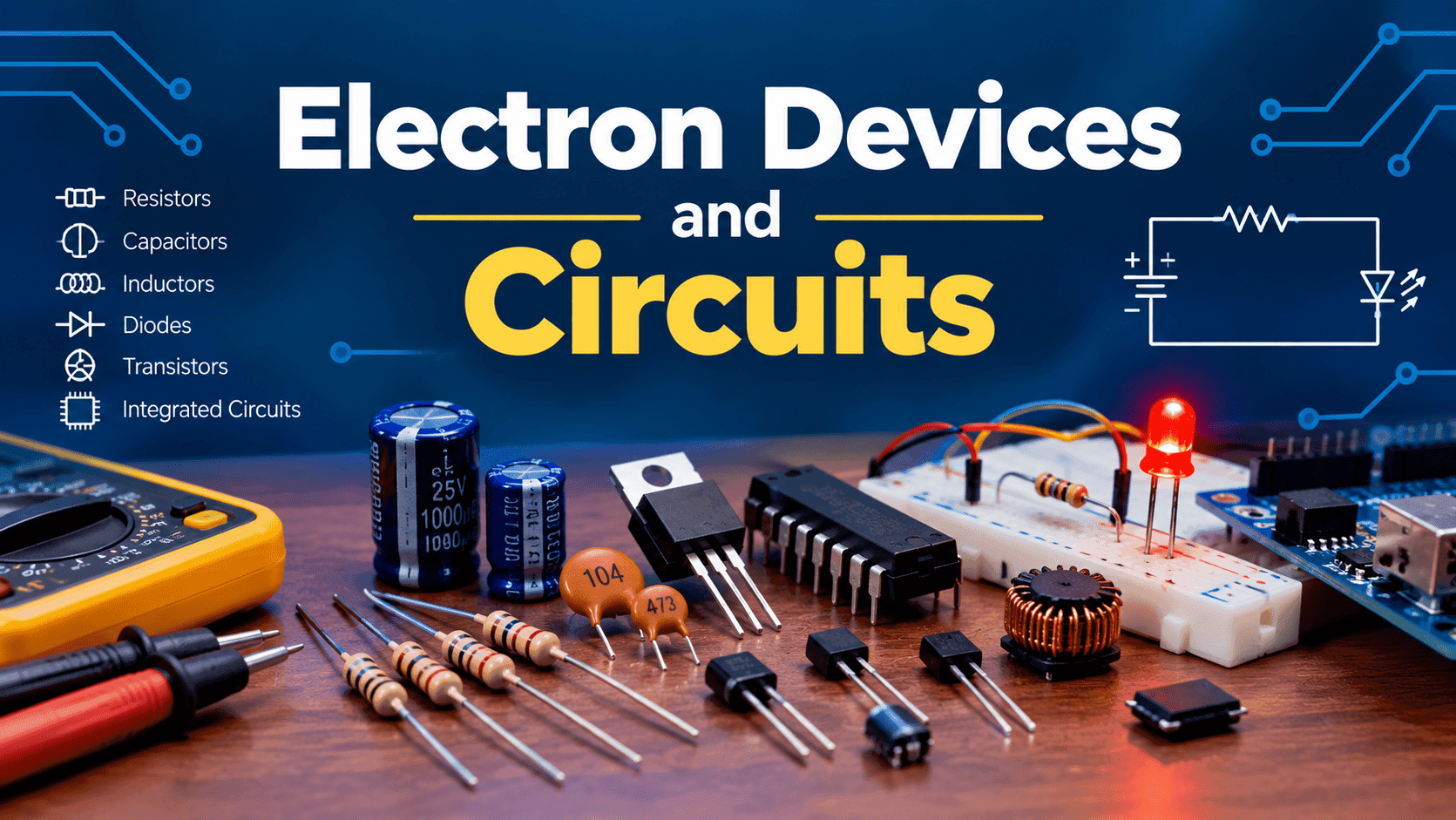
Electron Devices and Circuits are the foundation of modern electronic technology, powering everything from smartphones and computers to smart home appliances, electric vehicles, and communication systems. In 2026, understanding how electronic components work together is valuable for students, beginners, computer technicians, and technology enthusiasts who want to explore the world of electronics.
Electronic devices control electrical current, process signals, store information, and perform different functions through interconnected circuits. Whether you are studying electronics for academic purposes or learning how everyday technology works, understanding the basic principles of electron devices and circuits can help you develop practical technical knowledge.
In this article, we will explore seven core concepts of electron devices and circuits, including basic electronic components, semiconductor devices, analog and digital circuits, transistors, integrated circuits, power supply systems, and practical troubleshooting techniques.
1. Understanding the Fundamentals of Electronic Circuits
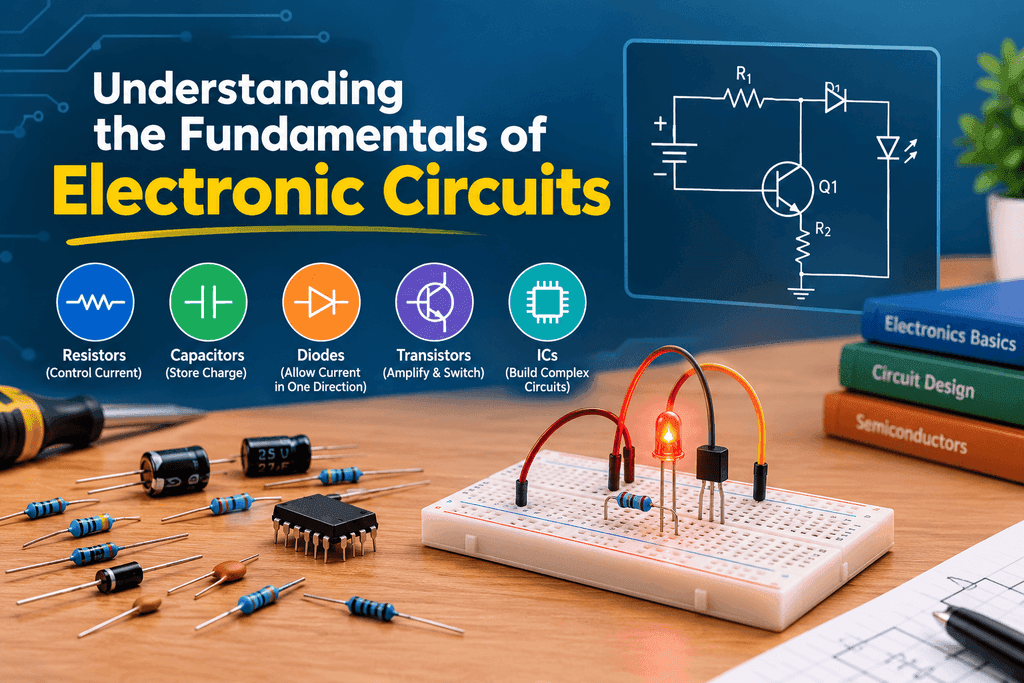
The first important concept in electron devices and circuits is understanding how an electronic circuit operates.
An electronic circuit is a connected arrangement of electrical and electronic components that allows current to flow and perform a specific function.
A basic electronic circuit typically contains:
- Power source: Provides electrical energy to the circuit.
- Conductive paths: Connect different components and allow current to flow.
- Electronic components: Control or modify electrical signals.
- Load: Uses electrical energy to perform a useful task.
For example, a simple LED circuit contains a battery, resistor, LED, and connecting wires. When the circuit is correctly connected, current flows through the LED, producing light.
Important Electrical Terms
Before studying electronic circuits, beginners should understand three fundamental electrical quantities.
Voltage: Voltage is the electrical potential difference between two points. It is measured in volts (V).
Current: Current represents the flow of electric charge through a conductor. It is measured in amperes (A).
Resistance: Resistance describes how strongly a component opposes current flow. It is measured in ohms (Ω).
These quantities are connected through Ohm’s law:
V=I×R
Where:
- V = Voltage
- I = Current
- R = Resistance
Understanding this relationship helps beginners calculate circuit values and understand how electronic components behave.
2. Passive Electronic Components: Resistors, Capacitors, and Inductors
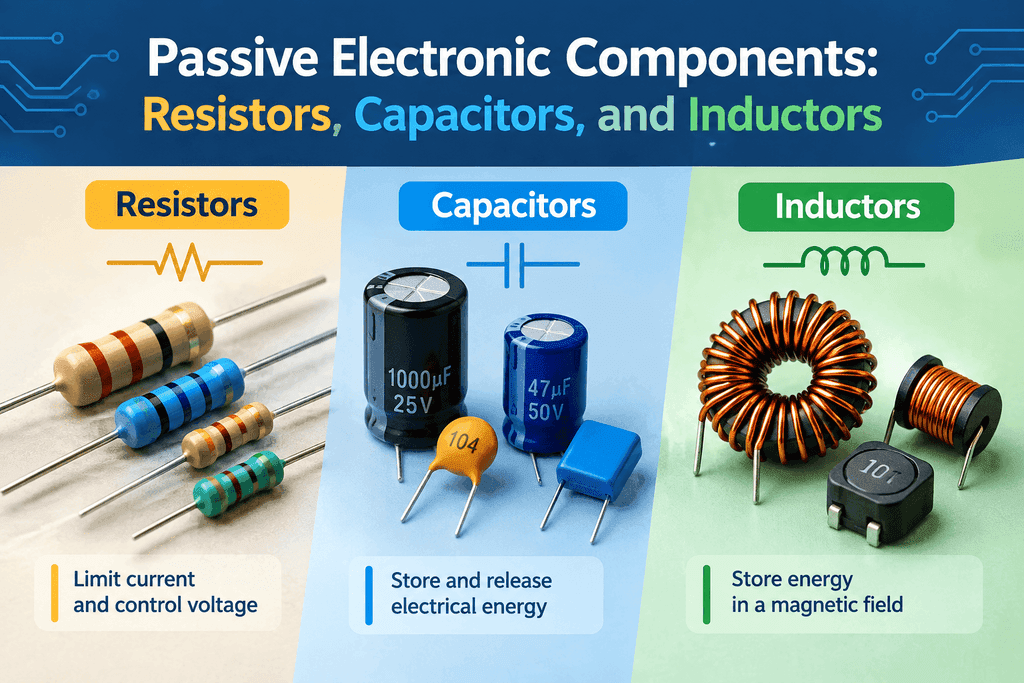
Passive electronic components are essential building blocks of electronic circuits. They control, store, or transfer electrical energy without providing power gain.
Three commonly used passive components are resistors, capacitors, and inductors.
Resistors
A resistor limits or controls electrical current in a circuit. It is commonly used to protect sensitive components, divide voltage, and establish appropriate operating conditions.
Common applications include:
- LED circuits
- Voltage divider circuits
- Electronic sensors
- Computer control boards
- Current-limiting circuits
For example, a resistor connected in series with an LED helps prevent excessive current from damaging the component.
Capacitors
A capacitor stores electrical energy in an electric field and releases it when required.
Capacitors are widely used in power supplies, audio systems, filtering circuits, and electronic timing applications.
Their main functions include:
- Smoothing voltage fluctuations
- Filtering unwanted electrical signals
- Temporarily storing electrical energy
- Supporting timing circuits
Capacitance is measured in farads (F).
Inductors
An inductor stores energy in a magnetic field when current flows through it.
Inductors are commonly found in switching power supplies,wireless communication equipment, and electronic filters.
They are especially useful in circuits that manage changing current and electrical energy.
Understanding passive components is important because these devices form the foundation of many electronic systems.
3. Semiconductor Devices: Diodes and Transistors
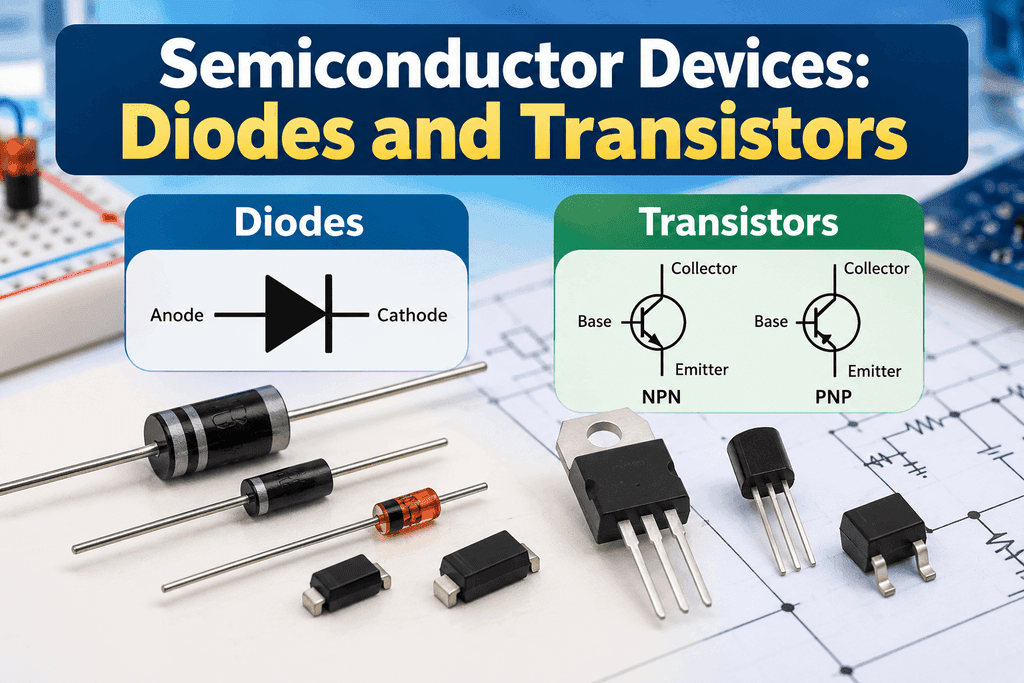
Semiconductor devices are among the most important components in modern electronics.
They are commonly manufactured using materials such as silicon,whose electrical properties can be controlled through processes such as doping and applied electric fields.
Two essential semiconductor devices are diodes and transistors.
Diodes
A diode is a semiconductor device that primarily allows current to flow in one direction.
It is commonly used in rectifier circuits, reverse-polarity protection, signal detection, and voltage regulation.
A light-emitting diode (LED) is a special type of diode that produces light when current flows through it in the forward direction.
Transistors
A transistor is a semiconductor device used to amplify or switch electronic signals.
Transistors are essential components in computers, smartphones, televisions, and communication equipment.
There are two major transistor categories:
Bipolar Junction Transistors (BJTs): These devices use electrons and holes as charge carriers and are controlled by current at the base terminal.
Field-Effect Transistors (FETs): These devices control current through an electric field. MOSFETs are widely used in digital electronics and power management.
Transistors allow electronic systems to perform switching, amplification, and signal processing.
4. Analog, Digital, and Mixed-Signal Circuits
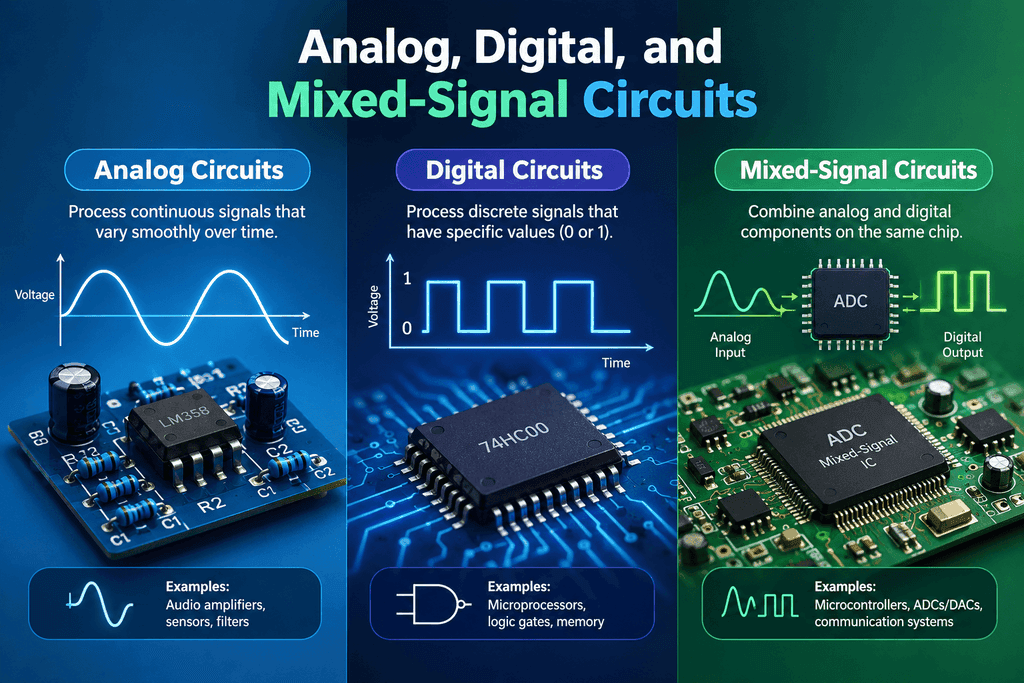
Electronic circuits are commonly classified according to the types of signals they process.
Understanding these categories helps explain how electronic devices handle information.
Analog Circuits
Analog circuits process continuously varying electrical signals.
Examples include:
- Audio amplifiers
- Radio receivers
- Temperature sensors
- Microphone circuits
An audio amplifier, for example, increases the strength of an electrical signal representing sound.
Digital Circuits
Digital circuits process information using discrete signal levels, commonly represented as binary 0 and 1.
They are used in computers, calculators, smartphones, and digital communication systems.
Common digital components include logic gates, flip-flops, counters, and microprocessors.
Mixed-Signal Circuits
Mixed-signal circuits combine analog and digital functions.
For example, a smartphone microphone receives an analog audio signal. An analog-to-digital converter changes that signal into digital information that the processor can handle.
Similarly, a digital-to-analog converter can convert digital audio data into an analog signal for playback through speakers.
These three circuit categories work together in many modern electronic devices.
5. Integrated Circuits and Microprocessors
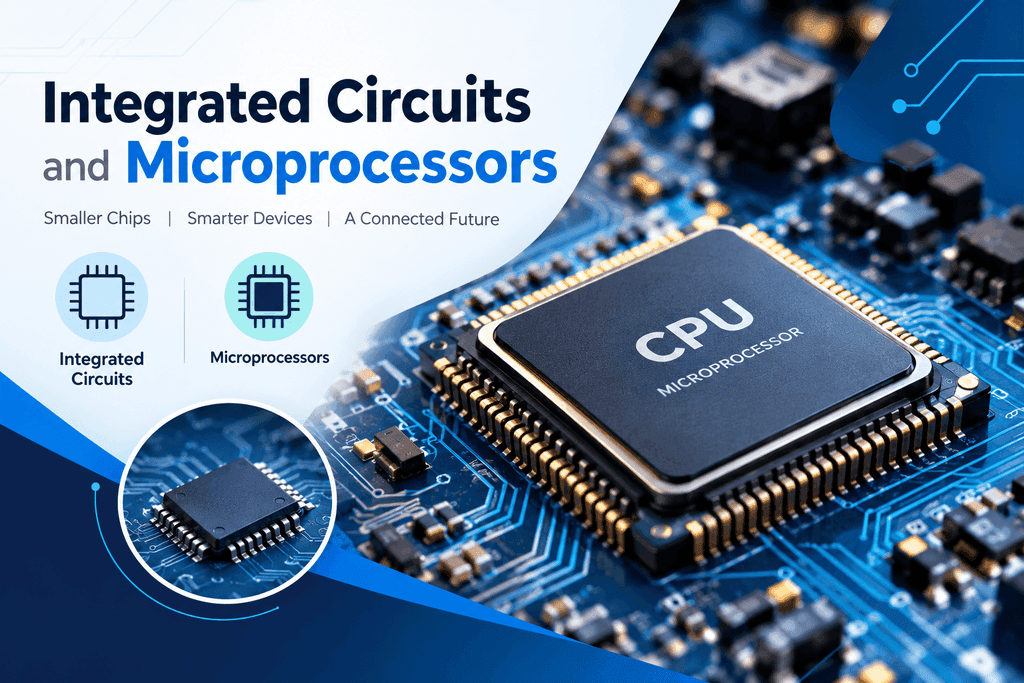
Integrated circuits, commonly called ICs, are compact electronic devices containing multiple interconnected components manufactured on a semiconductor chip.
They have transformed electronics by making devices smaller, faster, and more efficient.
Types of Integrated Circuits
Analog ICs: Used for amplification, filtering, and signal conditioning.
Digital ICs: Used for logic operations, data processing, and memory functions.
Mixed-Signal ICs: Combine analog and digital functions within a single chip.
Microprocessors
A microprocessor is an integrated circuit designed to execute instructions and perform calculations.
It serves as the central processing unit in many computing systems.
Microprocessors are used in:
- Desktop computers
- Laptops
- Smartphones
- Gaming systems
- Industrial equipment
Modern processors contain billions of transistors that work together to execute instructions and process information.
Microcontrollers
A microcontroller combines a processor, memory, and input/output peripherals in a single integrated circuit.
It is commonly used in embedded systems such as smart appliances, sensors, and automated control equipment.
Understanding integrated circuits is especially useful for students interested in computer hardware, electronics engineering, and embedded systems.
6. Power Supply Circuits and Voltage Regulation
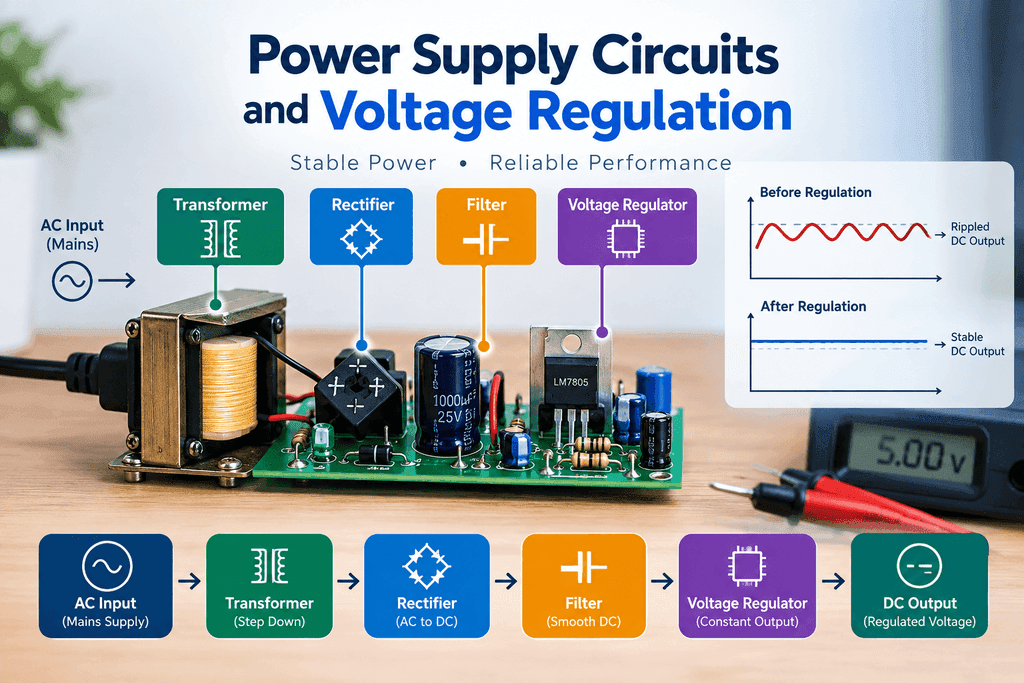
Power supply circuits provide suitable electrical energy to electronic devices.
Most electronic components require specific voltage and current levels to operate correctly.
A power supply circuit converts electrical energy from a source into a form suitable for the connected electronic system.
AC and DC Power
Alternating current (AC) periodically changes direction, while direct current (DC) flows in one direction.
Many electronic devices operate internally using DC power, even when connected to an AC electrical outlet.
Rectifier Circuits
Rectifiers use diodes to convert alternating current into pulsating direct current.
Common rectifier types include:
- Half-wave rectifiers
- Full-wave rectifiers
- Bridge rectifiers
A bridge rectifier uses four diodes to produce full-wave rectification.
Voltage Regulators
Voltage regulators maintain a relatively stable output voltage despite changes in input voltage or load conditions.
They are commonly used in computer motherboards, battery-powered devices, and electronic control systems.
Switching Power Supplies
Switching power supplies use high-speed electronic switching to regulate and convert electrical energy efficiently.
They are widely used in laptop chargers, desktop computers, televisions, and USB power adapters.
Understanding power supply circuits is important for safely operating, designing, and troubleshooting electronic devices.
7. Circuit Troubleshooting and Practical Applications
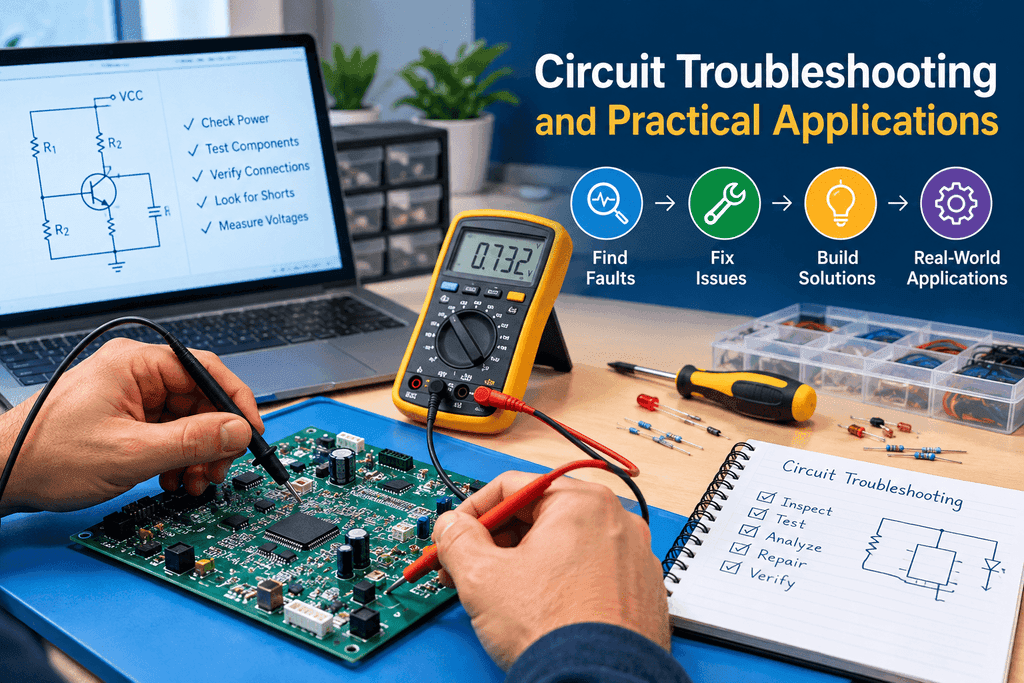
The final core concept is understanding how electronic circuits are tested, maintained, and used in real-world applications.
Circuit troubleshooting involves identifying problems that prevent an electronic system from operating correctly.
Common circuit problems include:
- Loose connections
- Damaged components
- Short circuits
- Incorrect voltage levels
- Overheating
- Faulty power supplies
Essential Electronics Testing Tools
Digital Multimeter: Measures voltage, current, resistance, and continuity.
Oscilloscope: Displays electrical signals over time and helps identify signal problems.
Breadboard: Allows beginners to build and test circuits without soldering.
Soldering Iron: Joins electronic components to circuit boards using solder.
Practical Applications of Electron Devices and Circuits
Electron devices and circuits are used across multiple industries.
| Industry | Common Applications |
|---|---|
| Computers | Processors, memory, power management |
| Smartphones | Touchscreens, sensors, wireless communication |
| Automotive | Engine control, sensors, safety systems |
| Healthcare | Patient monitors, diagnostic equipment |
| Communication | Wi-Fi routers, transmitters, receivers |
| Home electronics | TVs, refrigerators, smart appliances |
| Renewable energy | Solar inverters, battery controllers |
Practical projects such as LED circuits, transistor switches, and basic sensor systems can help beginners understand these applications.
When testing circuits, always use appropriate voltage levels and follow electrical safety precautions.
Why Electron Devices and Circuits Matter in 2026
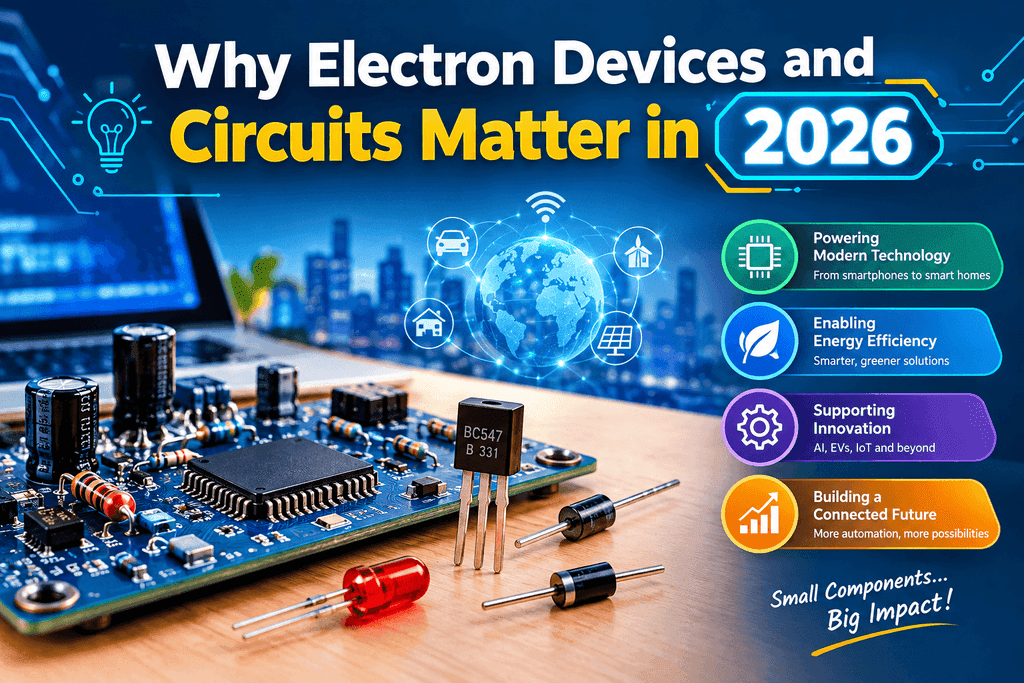
Electronic technology continues to develop rapidly, making knowledge of electron devices and circuits valuable for students, technicians, and technology enthusiasts.
In 2026, electronic circuits remain central to several important technology areas.
Artificial Intelligence Hardware
AI systems rely on specialized processors and semiconductor devices to perform complex calculations.
Internet of Things (IoT)
IoT devices use sensors, microcontrollers, and communication circuits to connect physical objects to digital networks.
Electric Vehicles
Electric vehicles depend on power electronics, battery management systems, motor controllers, and electronic safety circuits.
Smart Devices
Smart home appliances, wearable technology, and connected devices use compact electronic circuits to monitor conditions and perform automated tasks.
Learning the fundamentals of electronics provides a useful starting point for exploring these technologies.
Conclusion
Electron Devices and Circuits: 7 Core Concepts You Must Know (2026) introduces the essential principles behind modern electronic technology.
From basic electrical quantities and passive components to semiconductor devices, integrated circuits, power supplies, and troubleshooting, each concept contributes to understanding how electronic systems operate.
These seven concepts provide a foundation for learning electronics engineering, computer hardware, embedded systems, and modern semiconductor technology.
Whether you are a beginner, student, computer technician, or electronics enthusiast, developing practical knowledge of electron devices and circuits can help you understand existing technology and build your own electronic projects.
FAQ’s
1. What are the 7 core concepts in Electron Devices and Circuits every engineer should know?
Answer: The fundamental concepts include PN Junction Diodes, Bipolar Junction Transistors (BJTs), Field-Effect Transistors (FETs/MOSFETs), Operational Amplifiers (Op-Amps), Power Supplies/Voltage Regulators, Amplification & Frequency Response, and Feedback Mechanisms. Mastering these seven areas gives you a complete foundation in circuit design.
2. Why are Electron Devices and Circuits essential for modern hardware engineering in 2026?
Answer: They serve as the foundational building blocks for virtually all microelectronics—from smartphones and AI chipsets to electric vehicles and IoT sensors. Understanding how components manipulate electron flow allows engineers to design energy-efficient and high-performance hardware.
3. What is the difference between an electron device and an electronic circuit?
Answer: An electron device is an individual active component that controls electron movement (such as a diode, BJT, or MOSFET). An electronic circuit is an interconnected network combining these devices with passive components (resistors, capacitors, inductors) to perform complex tasks like signal processing or amplification.
4. How are wide-bandgap semiconductors like GaN and SiC impacting electronic circuits in 2026?
Answer: Silicon-carbide (SiC) and Gallium Nitride (GaN) are replacing traditional silicon in high-power and high-frequency applications. They allow electronic circuits to operate at higher voltages, switching speeds, and temperatures with significantly reduced power loss and smaller form factors.
5. Which simulation tools and books are best for learning Electron Devices and Circuits?
Answer: Standard reference books include Electronic Devices and Circuit Theory by Boylestad & Nashelsky and Microelectronic Circuits by Sedra & Smith. For practical learning, industry-standard simulation tools like LTspice, Cadence PSPICE, and Multisim are ideal for testing circuits before building physical prototypes.